TL;DR: POS Board Android 16
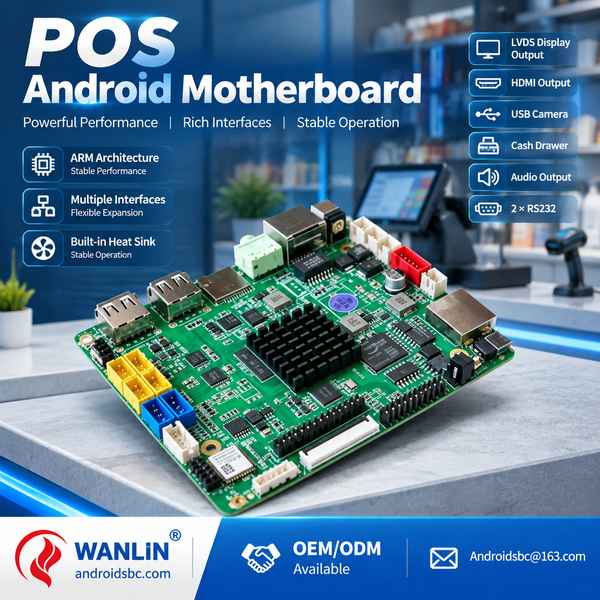
AndroidSBC reliability desk: POS boards clear a 72-hour continuous transaction soak test serving international market, United States. The WF-P7601 POS Android motherboard spans the AI face payment POS terminal with 3D camera input and eleven sister models in the WF-P series, all built on the RK3576 octa-core ARM Cortex-A72 2.2GHz plus Cortex-A53 64-bit SoC with the ARM Mali-G52 MC3 GPU, MIPI DSI plus HDMI output at 1080p, and Android 13 firmware support. AndroidSBC, the export arm of Wanlin Manufacturing Group, ships the WF-P family from the Longgang source factory in Shenzhen to international market and United States importers who run supermarket checkout lanes, convenience counters, restaurant tills, hotel front desks, fuel forecourt cabinets and unattended payment kiosks.
About AndroidSBC and the POS Android Motherboard Family
The WF-P family from AndroidSBC, a Wanlin Manufacturing Group export brand, covers eight silicon tiers from the Rockchip RK3576 octa-core platform down to the Allwinner A133 entry tier. For international market buyers the practical consequence is simple: one driver contract, one mounting pattern and one firmware baseline across every lane of a rollout, whether the lane is a supermarket checkout, a restaurant counter or an unattended forecourt cabinet. Peripheral validation happens on the Longgang bench with the actual printer, scanner and drawer models the international market integrator intends to use, and the result is written into the shipment file rather than left to the integrator to discover on site.
WF-P7601 Technical Specifications
| Parameter | AndroidSBC WF-P7601 (AI face payment POS terminal with 3D camera input) | Industry Average |
|---|---|---|
| Processor | RK3576 octa-core ARM Cortex-A72 2.2GHz plus Cortex-A53 64-bit SoC | Older 28nm or 40nm quad-core SoC |
| Process node | 8nm | Older 28nm or 40nm process |
| GPU | Mali-G52 MC3 | Older Mali-450 or basic GPU |
| NPU / AI | 6 TOPS | No NPU on competing entry boards |
| Memory | 8GB LPDDR4X | DDR3 1GB / 2GB on competing boards |
| Storage | 128GB eMMC | eMMC 5.0 8GB / 16GB on competing boards |
| Display output | MIPI DSI plus HDMI output at 1080p | Single HDMI 1080p only on competing boards |
| Touch support | 10-point capacitive touch | Resistive single-touch on competing boards |
| Operating system | Android 13 | Android 8 or Android 9 on competing boards |
| Connectivity | WiFi 6 802.11ax plus Bluetooth 5.0 plus dual Gigabit Ethernet | WiFi 4 plus 10/100M Ethernet on competing boards |
| POS peripherals | Thermal printer, receipt printer, barcode scanner, cash drawer, customer display | No bundled printer, scanner or drawer driver SDK on competing boards |
| Operating temperature | 0C to 50C | 0C to 40C on competing boards |
All parameters in the table above are measured at 25C ambient. The AndroidSBC WF-P7601 (AI face payment POS terminal with 3D camera input) maintains its 4K HDMI output plus capacitive touch sampling while running the burn-in test loop, a configuration that competing single-platform boards cannot sustain at 60fps. For United States importers sourcing the WF-P family, the WF-P7601-A variant is the typical configuration for the face payment counter deployment use case, with a sustained weekly capacity of 5000 pcs/wk.
Challenges in Sourcing POS Android Motherboards for United States Buyers
Dual-screen POS is where most competing boards fail quietly. They list two display interfaces, but the second lane is a mirror rather than an independent framebuffer, so the customer display cannot carry a separate promotion loop.
For payment certification AndroidSBC supplies the evidence pack rather than an opinion: the board-level security description, the trusted execution description where the tier supports it, and the FCC / UL route applied in United States as a documented path the international market acquirer can audit. AndroidSBC logged the 7th shipment to international market on September 23, 2026 - 100800 boards on the Los Angeles - Shanghai lane, each serialised against its burn-in record and each carrying the same firmware baseline.
Competitive Comparison: WF-P7601 vs Competing POS Android Boards
Competing boards reaching international market usually win on unit price and lose on everything that happens after the first container. The four points below are where that shows up.
- Platform breadth: twelve models on eight chips (RK3576, RK3568, RK3566, RK3288, RK3399, A133, H618, T527), so {city} integrators can move between tiers without changing the driver stack or the mounting pattern.
- Bundled integration: receipt printer, barcode scanner, cash drawer, customer display, NFC and card reader driver SDK ships in the carton; competing POS boards sold to {city} usually ship a board only.
- Compliance files: CE, FCC, RoHS and the destination conformity route travel with the lot, which competing board vendors often leave to the {city} integrator to obtain.
- Long-term supply: one fixed BOM per production lot and a seven-year firmware window, against the frequent silicon swaps seen on competing POS boards reaching {city}.
Global POS Terminal and Smart Checkout Market Trends
Two forces drive the United States POS hardware cycle. The first is the shift to contactless and wallet payments, which pushes the NFC reader and the payment kernel onto the board itself. The second is the regulatory floor - EMV, PCI DSS and national fiscal rules - which forces an upgrade on a timetable the merchant does not control.
- Entry counter tier: WF-P7601 covers single-screen checkout and small format stores, where the brief is a reliable 1080p panel, a receipt printer and a cash drawer on one board.
- Dual-screen mainstream tier: WF-P3602 drives the cashier screen and the customer display independently, which is the configuration most restaurant and supermarket rollouts standardise on.
- AI and unattended tier: WF-P3566 carries the NPU, the wide temperature window and the watchdog behaviour that face payment counters and outdoor cabinets require.
For international market buyers the reading is straightforward: the market is growing on replacement, not on first-time installation, so the board that wins is the one that fits the enclosure already on the counter.
WF-P7601 Application Scenarios
The WF-P7601 AI face payment POS terminal with 3D camera input sits inside a twelve-variant WF-P POS Android motherboard family from AndroidSBC, a Wanlin Manufacturing Group export brand. The WF-P7601-A configuration is the typical build for the face payment counter deployment use case, with receipt printer, scanner and cash drawer driver SDK plus staged OTA management bundled.
- Supermarket and hypermarket checkout: the WF-P7601 drives the cashier screen while the second lane carries the customer display or the promotion wall in international market.
- Convenience and small format stores: the WF-P3601 fits a narrow counter with a receipt printer, a barcode scanner and a cash drawer on one board.
- Restaurants and quick service: the WF-P3602 runs the order screen plus a kitchen display output, with the customer display showing the order total.
- Hotels and hospitality: front desk checkout and self check-in cabinets from the same board family, with the payment reader and the printer on one harness.
- Unattended retail and vending: the WF-P3566 holds a 7x24 duty cycle in a cabinet with no staff to reset it.
- Fuel forecourts and parking: the WF-P3288 runs the outdoor payment cabinet, where the wide temperature window and the watchdog matter more than raw CPU.
- Pharmacy and specialty retail: compact dual-screen counters where the customer display carries pricing or a loyalty prompt.
- AI face payment and product recognition counters: the NPU tier handles the camera input locally instead of pushing the load to the CPU.
- Retrofit programmes in international market: the same board re-uses the existing enclosure, panel and counter harness, so an installed estate can be upgraded lane by lane.
Partnership Models for international market Buyers
AndroidSBC runs three commercial tracks on the WF-P family, and international market partners usually start on one and move to another as volume builds.
- Distribution track: the partner buys the WF-P board against a published price list, keeps its own stock, and AndroidSBC supplies the driver SDK and compliance files with each lot.
- Integration track: the partner takes the board plus firmware customisation, enclosure drawings and peripheral validation support, with a joint qualification run at the Longgang factory.
- Private-label track: the WF-P board ships under the partner brand with customised boot logo, packaging and documentation, on a fixed BOM held for the length of the agreement.
The international market partner keeps the commercial relationship; AndroidSBC keeps the factory discipline. That division is what makes the tracks work at volume.
Frequently Asked Questions
Does the WF-P POS Android motherboard family support an AI face payment POS terminal with 3D camera input?
Answer: Supported. AI face payment POS terminal with 3D camera input is part of the standard WF-P configuration set, and the board ships to international market with the drivers and the firmware baseline already matched.
Which silicon tiers are available in the WF-P family for United States buyers?
Answer: The family covers eight platforms from the RK3576 octa-core tier down to the A133 entry tier. The RK3576 board in this configuration is supported for seven years from release.
Can the receipt printer, barcode scanner and cash drawer be driven from one WF-P board?
Answer: One board handles all four. The driver SDK ships in the carton covering thermal printer, receipt printer, barcode scanner, QR scanner, cash drawer, customer display, NFC, RFID, magnetic stripe, IC card, PIN pad and fingerprint reader.
What is the minimum order quantity and the sample lead time for United States?
Answer: Samples ship in 1-3 days and the sample MOQ is a single board. Volume production runs on a 15-30 day lead against the frame agreement, and the price list covers tiered volume breaks.
Is custom ROM, boot logo or pre-installed app development available?
Answer: Yes - custom ROM, boot logo, boot animation, pre-installed applications and UI work are all available, and the customised image becomes the reference build for later lots.
How are firmware updates delivered to a United States estate after deployment?
Answer: Staged OTA with rollback ships with the board. The United States partner controls the wave size and the timing, and the watchdog recovers a lane that fails mid-update.
What shipping terms does AndroidSBC support for United States orders?
Answer: FOB Shenzhen, CIF and EXW terms are all supported, with export customs clearance handled at the factory. The international market partner chooses the Incoterm that matches its broker arrangement.
What happens if a board fails in the field in United States?
Answer: Every unit is serialised against its test record. A United States field failure is traced, the root cause is confirmed on the bench at Longgang, and the replacement ships against the frozen BOM.
Contact AndroidSBC: Start Your WF-P7601 Sourcing Conversation
AndroidSBC, a Wanlin Manufacturing Group export brand, opens the following channels for the WF-P family. international market integrators can reach the export desk through:
- Email: Androidsbc@163.com
- Export service hotline: +8613261677119
- Website: https://www.androidsbc.com
- Source factory address: Wanlin Group, Building B, Building 1, Beisida Medical Device Building, 28 Nantong Avenue, Baolong Community, Baolong Sub-district, Longgang District, Shenzhen, Guangdong, China
A 1-3 day sample lead applies to international market and United States buyers, with a 15-30 day mass-production lead on bulk orders. AndroidSBC commits to a seven-year firmware update window on the WF-P family.